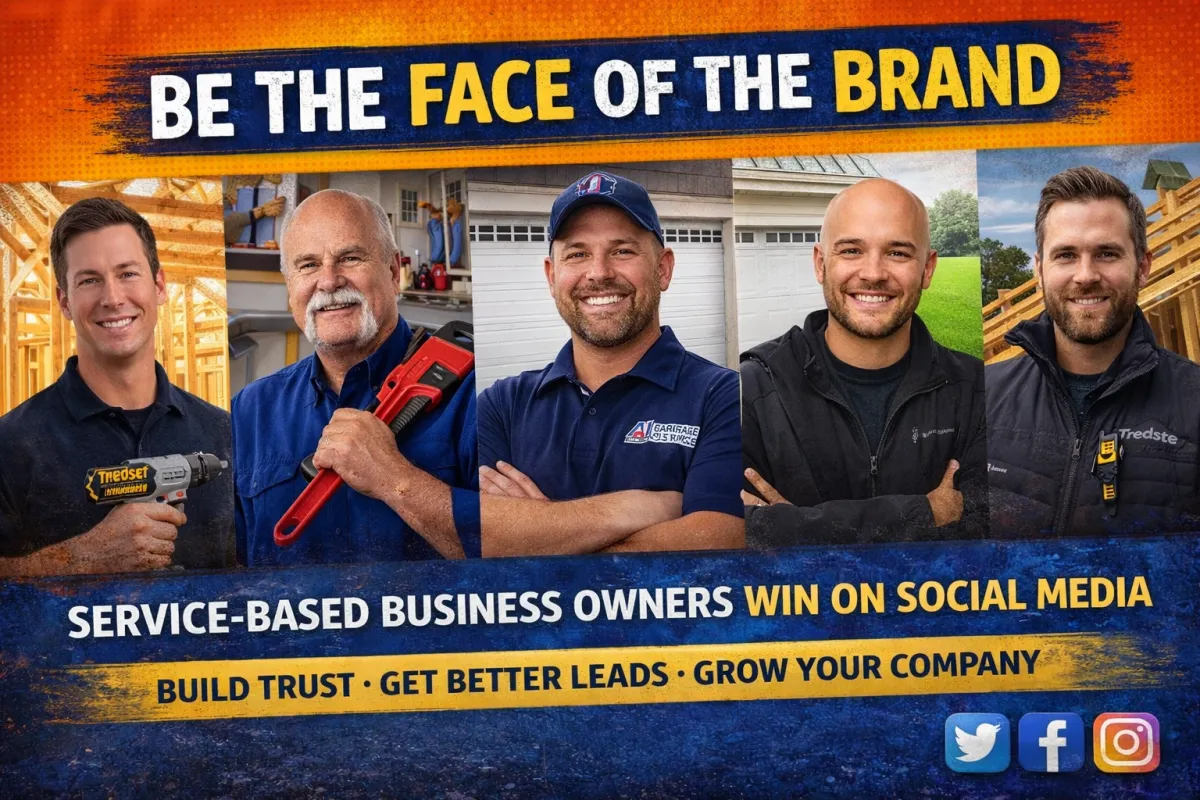
Why Service-Based Business Owners Need to Be the Face of the Brand on Social Media
If you own a service-based business, your marketing is not competing against other service companies. It’s competing against uncertainty.
When someone needs a roofer, electrician, landscaper, remodeler, HVAC tech, or plumber, they’re not just buying a service. They are buying trust. They are buying reliability. They are buying the belief that you will show up, communicate clearly, and do the job right.
That is exactly why it is so important for service business owners to be the face of the brand on social media. Not “your company” on social media. You.
The harsh truth
In most service industries, the service itself looks similar online. Photos of trucks, crews, and finished jobs blur together. The differentiator becomes the person behind it, the standards, and the proof.
When you are present on social media, you reduce uncertainty at scale. That means more inbound leads, better clients, higher close rates, and a shorter sales cycle.
This post breaks down why it works, what to post, and who is doing it well in construction and home services so you can model what is proven.
Why being the face of the brand works for service businesses
1) Trust moves faster when people can see you
Most prospects are not searching for the “best contractor in town.” They are searching for a safe choice.
When you show your face consistently, you create familiarity. Familiarity lowers perceived risk. Lower risk leads to action.
A business logo does not create trust. A person with a clear message and consistent proof does.
2) It makes your brand harder to replace
If your company posts generic tips and job photos, you become interchangeable.
If you become known for your standards, your process, your perspective, and your results, you become the default option. That is the difference between a content creator and a market leader.
Your personal brand becomes a moat.
3) It shortens the sales cycle
When a prospect has watched you explain common problems, show how you work, and demonstrate proof, the conversation changes.
They stop asking, “Can you do this?”
They start asking, “When can you get here?”
That is a shorter sales cycle and better leads.
4) It attracts better clients and repels the wrong ones
Service businesses lose money on bad-fit clients. Price shoppers. Unrealistic expectations. People who do not respect the process.
When you are the face of the brand, you can set expectations publicly:
what you prioritize
how you communicate
how your process works
what quality looks like
what you do not do
That filters your leads before they ever message you.
5) It improves recruiting and retention
Great people want to work with great operators.
A strong owner-led brand becomes a recruiting engine because it signals:
leadership
standards
stability
culture
professionalism
This is one of the most overlooked benefits of being visible.
6) It builds “proof” without sounding salesy
Owners hesitate to talk about themselves because they do not want to look arrogant.
But service buyers want to know:
have you done this before
do you know what you are doing
can I trust you
do others trust you
When you show the process, the standards, and the results, it is not bragging. It is proof.
What “being the face” actually means
You do not need to be an influencer. You need to be present.
Being the face of the brand means:
you show up on camera regularly
you explain problems clearly
you show how you work
you share results and proof
you tell people what to do next
That’s it.
You can do this in a truck, on a job site, in your office, or in a simple studio setup. What matters is consistency.
The content types that work best when the owner is visible
If you want leads, stop posting random. Run a system.
Trust content
This builds familiarity and connection.
your values and standards
behind-the-scenes of real work
why you started
what you care about in the work
Authority content
This builds credibility.
explain common mistakes customers make
myth-busting
“here’s what I’d do if this was my house”
how to think about timelines, pricing, materials
Proof content
This reduces doubt.
before and after with context
mini case studies: problem, process, result
reviews with an explanation of what happened
“here’s what we fixed and why it mattered”
Offer content
This creates action.
availability
what to do next
DM keyword calls to action
“here’s how to get an estimate”
The point is simple: if you want leads, proof and offer content must show up weekly.
Common objections owners have, and the real answers
“I’m not good on camera”
You do not need to be smooth. You need to be clear.
The best performing service content is often the most direct:
Here’s the problem
Here’s what causes it
Here’s what we do
Here’s what to do next
If you can explain your work to a customer on-site, you can do it on camera.
“I don’t want to give away too much”
Teach diagnosis, not full implementation.
Give people:
what to look for
what matters
what the right next step is
Do not give away:
full checklists
full scripts
custom plans
full scopes and pricing breakdowns
Your content should create clarity. Your service installs the solution.
“I don’t have time”
You do not need daily posting.
A realistic service-owner cadence:
2 short videos per week
1 proof post per week
1 offer post per week
Batch film once every two weeks. Use your phone. Keep it simple.
Examples of service and construction leaders doing this well
Below are real examples you can study. The goal is not to copy their personality. The goal is to copy the structure: education, standards, proof, and consistency.
1) Matt Risinger (construction and building science)
Matt Risinger runs The Build Show, where he educates homeowners and builders on high-performance construction and showcases projects and best practices. His content works because he leads with standards and expertise, not generic contractor marketing.
What to learn from him:
teach the “why” behind good work
show process and materials in real time
make the owner the trusted guide
2) Nick Schiffer (NS Builders)
Nick Schiffer and NS Builders are a strong example of using social media to document craftsmanship, storytelling, and premium positioning. He also explicitly discusses brand awareness and how to build a brand around quality.
What to learn from him:
document the build, step by step
show standards relentlessly
premium clients follow premium positioning
3) Roger Wakefield (plumbing education and marketing)
Roger Wakefield is a plumber who built a large education-driven channel and regularly speaks about using social media and YouTube for plumbing business growth.
What to learn from him:
use education to build trust at scale
build a repeatable series format
show personality while staying professional
4) Tommy Mello (home services operator brand)
Tommy Mello is a well-known home services operator and media personality tied to A1 Garage Door Service and The Home Service Expert. His personal brand is built around systems, leadership, and business growth content for the home service world.
What to learn from him:
build authority through operational thinking
use podcasts and speaking as brand multipliers
position yourself as an industry leader, not just a local company
5) Mike Andes (lawn care and home service business education)
Mike Andes built a strong owner-led brand around professionalizing home services and teaching operators how to grow. He publishes content tied to real business operation, not surface-level marketing.
What to learn from him:
make the owner the educator
focus on systems and execution
create a clear content engine that compounds
6) Roofing Insights (roofing industry media)
Roofing Insights is a prominent roofing industry channel focused on education and insights. Whether you agree with every take is not the point. The point is that the channel has built attention in a traditionally offline industry by consistently publishing niche-specific content.
What to learn from it:
own a niche category with consistent publishing
go deeper than surface-level tips
become the reference point in your space
What you should do this week if you want to be the face of the brand
Here’s a simple starting plan that does not overwhelm you.
Step 1: Record 5 “job site” videos (15 to 30 seconds each)
Prompts:
“Here’s what caused this problem.”
“Here’s what we’re doing to fix it.”
“Here’s what most people get wrong about this.”
“Here’s what quality looks like on this job.”
“If you’re dealing with this, DM me QUOTE.”
Step 2: Post one proof piece
Before and after, plus a caption that explains:
problem
process
result
next step
Step 3: Post one direct offer
Do not apologize. Do not hedge.
“We have openings next week for X. DM AVAILABILITY.”
Step 4: Respond fast and ask one question
Your first DM reply should be one question that moves the conversation forward:
“What’s the issue and what’s your timeline?”
That is how content turns into booked work.
The bottom line
Service businesses win when they remove uncertainty.
Being the face of the brand does that better than anything else because it creates:
familiarity
trust
proof
differentiation
faster conversion
If you want better leads, higher trust, and a shorter sales cycle, this is not optional. You do not need to be famous. You need to be present.
Call to action
If you want help building an owner-led personal brand that drives leads without you posting random content, Manage to Create can help you install a simple system: profile clarity, content mix, proof strategy, CTAs, and DM follow-up.
